Published: May 2025 | 8-minute read
If you manage IT for a business with multiple locations or if you’re planning to add locations you’ve probably run into the terms SD-WAN and MPLS. If your not using SD WAN today then your likely on MPLS. A carrier rep likely told you MPLS was strategic. A colleague in LinkedIn group swears by one or the other. And if you asked three different people to explain the difference, you’d probably get three different answers.
This article cuts through the noise. Here’s an honest, practical comparison of SD-WAN and private MPLS, what each one is, where each one excels, and how to think about which approach is right for your business.
First: What Problem Are We Actually Solving?
Before we get into technology specifics, let’s agree on the problem.
If you have a single office, your WAN (Wide Area Network) strategy is straightforward: get the best internet circuit you can afford and move on. But when you have multiple locations: a headquarters, branch offices, remote workers, retail locations, or distributed warehouses etc, you need a way to connect all of those locations reliably, securely, and cost-effectively.
That’s the WAN problem. MPLS and SD-WAN are two different architectural answers to that problem.
What Is MPLS?
MPLS stands for Multiprotocol Label Switching. It’s been the gold standard for enterprise networking for over two decades, and for good reason. In fact, 70-75% of large enterprises are still using MPLS at some capacity in their WAN environment.
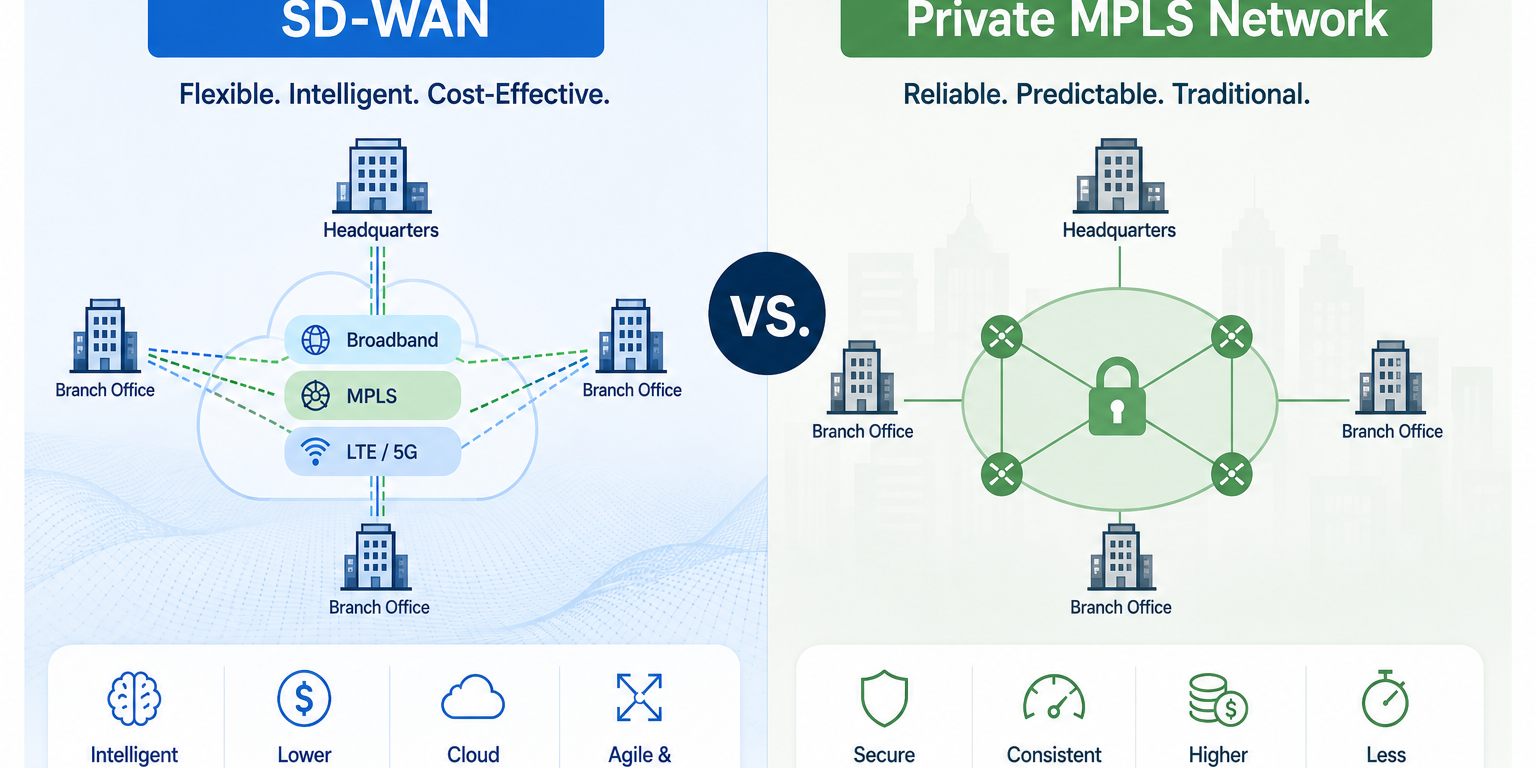
Here’s how it works in plain terms: your carrier builds a private network that connects your locations to each other. This network never touches the public internet. Traffic between your offices travels through the carrier’s own infrastructure and their routers, their fiber, their backbone with a guaranteed level of performance.
What makes MPLS special:
-
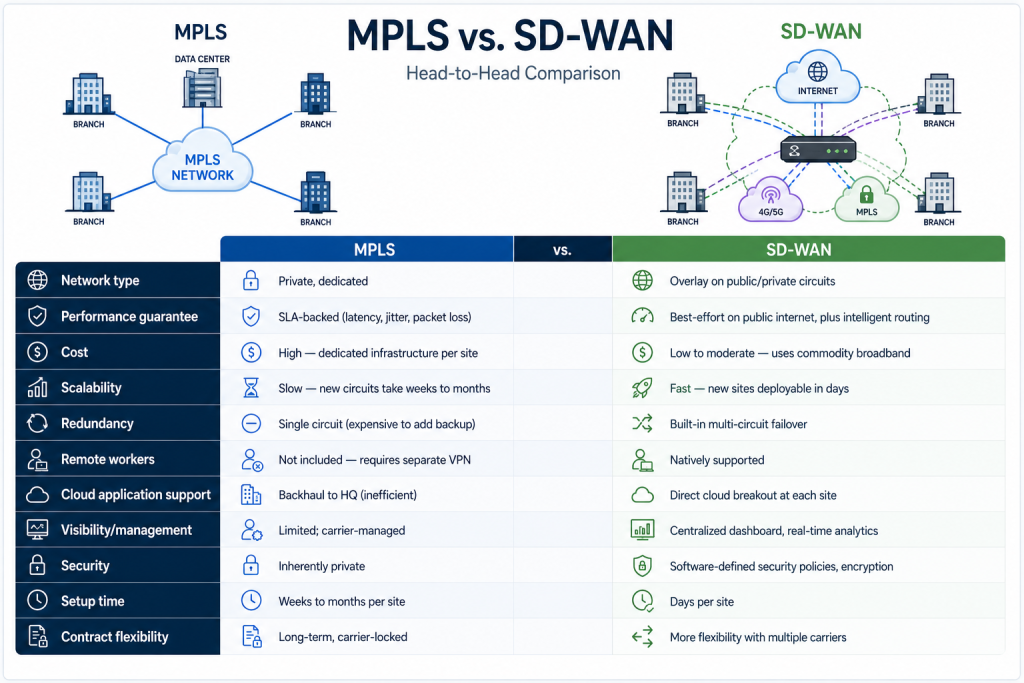
- It’s private. Your data never traverses the public internet. There’s no shared bandwidth with other businesses or consumers.
- It’s predictable. Carriers offer SLAs (Service Level Agreements) that contractually guarantee latency, jitter, and packet loss. For real-time applications like VoIP, video conferencing, and manufacturing control systems, this matters enormously.
- It’s engineered for QoS. Quality of Service controls are built into MPLS from the ground up. Your phone calls get prioritized over a file download. Automatically. Always.
- It’s proven. Banks, hospitals, law firms, and manufacturers have relied on MPLS networks for critical operations for over 20 years. The technology is mature and thoroughly understood.
The catch:
MPLS is expensive. You’re paying for a carrier to build and maintain a dedicated private network between your locations. And because that network is entirely within the carrier’s infrastructure, every new site requires the carrier to provision a new circuit which can take weeks to months and adds significant cost.
MPLS also has very limited flexibility for remote or mobile workers. If your employee isn’t at one of the offices on the MPLS network, they’re on the public internet which creates a different connectivity experience and often requires a separate VPN solution layered on top.
What Is SD-WAN?
SD-WAN stands for Software-Defined Wide Area Network. It’s a fundamentally different approach and one that’s matured significantly over the last five years.
Instead of replacing the underlying network infrastructure, SD-WAN adds an intelligent software layer on top of whatever internet circuits you already have (or acquire). That software layer makes real-time decisions about how to route traffic across multiple circuits dynamically, automatically, and based on the actual performance of each circuit at any given moment.
What makes SD-WAN special:
-
- It works with any circuit type. Fiber, cable broadband, LTE/5G, fixed wireless and SD-WAN treats them all as inputs and intelligently balances traffic across them.
- It provides automatic failover. If your primary circuit degrades or goes down, SD-WAN detects it in milliseconds and shifts traffic to your backup circuit. Your team might never notice the primary went down.
- It gives you visibility. A central dashboard shows performance metrics across all of your sites and circuits in real time. Troubleshooting becomes dramatically faster.
- It’s cost-effective. You can often replace a single expensive MPLS circuit with a DIA and a lower-cost broadband circuit to achieve better aggregate bandwidth at a lower monthly cost.
- It scales fast. Adding a new site to an SD-WAN network can be done in days, not months. Devices can be pre-configured and shipped to locations for plug-and-play deployment.
- It’s built for hybrid work. Modern SD-WAN platforms extend to remote workers, cloud applications, and mobile users giving you consistent policy and security enforcement regardless of where people are connecting from.
The catch:
SD-WAN runs on top of the public internet (or a combination of private and public circuits). Even with intelligent routing, you’re subject to the variability of internet performance. For most applications such as cloud software, file sharing, even most VoIP this variability is imperceptible. But for applications with very strict latency requirements (think: real-time trading systems, certain medical devices, or highly latency-sensitive manufacturing equipment), that variability can matter. Which is why we recommend Fiber DIA for primary links rather than broadband.
SD-WAN also introduces software complexity. You’re managing an intelligent platform, not just circuits. If something goes wrong, diagnosing the issue requires understanding both the underlying circuits and the SD-WAN platform behavior. Having an experienced partner is important.
Who Should Choose MPLS?
MPLS remains the right choice for a specific type of organization:
- Businesses with strict latency requirements — if you run real-time systems where even 10–20ms of added latency causes operational problems, MPLS’s guaranteed performance is worth the cost
- Highly regulated industries — healthcare organizations, financial institutions, and government contractors often face compliance requirements that MPLS’s private network model satisfies more cleanly
- Large enterprises with established MPLS infrastructure — if you’ve already invested in an MPLS network and it’s working well, the disruption of migrating may not be worth the savings. It really depends on where your branch offices are what bandwidth they can get.
- Businesses with minimal cloud usage — if your applications live entirely on-premises and you’re connecting fixed offices to a central data center, MPLS’s hub-and-spoke model works cleanly
That said, even many of these organizations are adopting hybrid models. Keeping MPLS for the most latency-sensitive traffic while adding SD-WAN for cloud applications and remote worker connectivity.
Who Should Choose SD-WAN?
SD-WAN is the right choice for the majority of modern businesses:
- Multi-location businesses — retail chains, service businesses with multiple offices, franchise organizations, healthcare practices with multiple locations
- Cloud-heavy operations — if your team lives in Microsoft 365, Salesforce, Google Workspace, or other cloud applications, SD-WAN’s direct cloud breakout eliminates the inefficiency of backhauling traffic through a central hub
- Businesses with hybrid or remote workforces — SD-WAN extends naturally to remote users with consistent security and performance policies
- Growing businesses — if you’re opening new locations, SD-WAN’s fast deployment and lower cost per site is a significant advantage
- IT-lean organizations — SD-WAN’s centralized management dashboard is genuinely easier to operate than managing individual MPLS circuits through a carrier portal
The Hybrid Approach: Getting the Best of Both
Here’s what we recommend for many mid-sized businesses: don’t think of MPLS and SD-WAN as mutually exclusive.
The most sophisticated WAN architectures today use SD-WAN as the management and routing layer across a mix of circuit types — including private MPLS circuits at the most critical sites, dedicated fiber at high-traffic locations, and broadband backup circuits everywhere.
This approach gives you:
- Guaranteed performance where it matters most (MPLS or dedicated fiber at HQ or primary data center)
- Cost-effective connectivity at branch offices (broadband + SD-WAN overlay)
- Automatic failover everywhere (SD-WAN detects degradation and reroutes in real time)
- One management pane for the entire network (SD-WAN dashboard, regardless of underlying circuit type)
- Flexibility to add remote workers, cloud applications, and new sites without touching the core network design
A dental group with 8 locations, for example, might run dedicated fiber at their largest location (where their server and patient records system lives), broadband + LTE backup at each branch location with SD-WAN managing automatic failover, and a cloud-hosted VoIP platform that routes through the SD-WAN fabric all managed through a single dashboard, with one partner to call when something goes wrong.
What This Costs in the Real World
Pricing varies significantly by location and provider, but here are realistic ballpark figures to frame the conversation:
MPLS (per site, per month):
- Small site (10Mbps): $400–$700/month
- Mid-size site (50Mbps): $800–$1,500/month
- Large site (100Mbps+): $1,500–$4,000+/month
SD-WAN with broadband circuits (per site, per month):
- SD-WAN platform fee: $100–$300/month per site
- Primary DIA circuit (100–500Mbps): $300–$900/month
- Broadband back up circuit: $100- $300/month
- Total per site: $250–$700/month for better aggregate bandwidth and built-in redundancy
For a 5-site organization, the difference can be $3,000–$8,000 per month in favor of SD-WAN, while actually delivering more bandwidth, more redundancy, and better visibility than a comparable MPLS deployment.
How to Decide: Three Questions to Ask
If you’re unsure which direction is right for your business, start here:
- What’s your most latency-sensitive application? If your answer is “Microsoft Teams and Salesforce,” SD-WAN is almost certainly sufficient. If your answer is a real-time trading platform, a manufacturing SCADA system, or an application your software vendor explicitly requires MPLS for that changes.
- How many sites do you have, and how fast are you growing? More sites and faster growth favor SD-WAN’s deployment speed and cost efficiency. Stable, smaller networks where performance is critical may still favor MPLS.
- How much of your business is in the cloud vs. on-premises? Cloud-heavy operations benefit enormously from SD-WAN’s direct cloud breakout. On-prem-heavy operations fit MPLS’s hub-and-spoke model more naturally.
Working with an Independent Partner
One more thing worth saying: your carrier will almost always recommend their own product. An AT&T rep recommends AT&T MPLS or some new Network as a service solution. A Comcast Business rep recommends Comcast broadband with their SD-WAN overlay.
At Agility Communications, we work with 20+ carriers and multiple SD-WAN platforms. Our recommendation is based entirely on what’s right for your specific situation — your locations, your applications, your budget, and your tolerance for complexity.
We design the network, manage the carrier relationships, project-manage the deployment, and stay as your single point of contact for the life of the solution. When a circuit goes down or performance degrades, you call us — not six different carrier 800 numbers.
If you’re managing a multi-location network and you’re unsure whether your current architecture is serving you well, let’s have a conversation. We’ll take a look at what you have, benchmark it against what’s available, and give you an honest assessment.
Request your free site survey today — we’ll do the research so you don’t have to.
Ready to Design the Right Network for Your Business?
📞 Call us:
- Utah: 435-215-1120
- Idaho: 208-221-8573
- Nevada: 702-708-1570
- California: 714-983-5883
🌐 Visit: agilitycommunications.net
📧 Email: mike@agilitycommunications.net
Request a free network design consultation — we’ll map out the right WAN architecture for your locations, applications, and budget.
About Agility Communications
Agility Communications is an independent technology partner serving businesses across Utah, Nevada, Idaho, and California. We specialize in business fiber internet, WAN connectivity, SD-WAN solutions, VoIP phone systems, AI receptionist solutions, and cloud IT services. As an independent agent, we work with 20+ carriers to deliver the right technology at the right price — with one trusted partner to call when you need support.